
What About Due Dates?
In 1744, a Dutch professor named Hermann Boerhaave analyzed the records of 100 pregnant women and proposed adding seven days to the last menstrual period (LMP), followed by adding nine months. But Boerhaave did not specify whether the seven days should be added to the first or last day of the last period! In 1812, German professor Franz Naegele endorsed Boerhaave’s approach but still failed to clarify whether the count should begin from the start or end of the LMP. This made things unclear. In Naegele’s time (the 1800s), doctors commonly added the seven days to the last day of the last period. Yet by the 1900s, for reasons that remain unclear, American medical textbooks began promoting the first day of the last menstrual period as the starting point. This version is used today by nearly all doctors. They add seven days to the woman’s first day of LMP and then count forward nine months, or 280 days.
The idea that pregnancy lasts 280 days, or 10 lunar months, must be looked at in the context of the historical difficulty of aligning lunar and solar calendars. The lunar cycle governs the concept of months, while the solar cycle dictates the seasons. Because these cycles do not align perfectly, various societies developed inter-calendar days to reconcile the difference. Today’s Gregorian calendar, which emphasizes solar time, accommodates months that only roughly correspond to the moon’s phases.
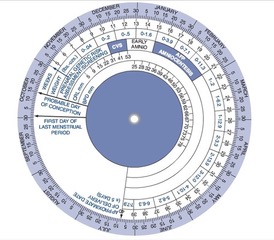
We’ve been using Naegele’s rule for centuries (the little circle calendar at the OB’s office), but it is completely unsubstantiated by any large-scale research and was based on the observation of just 100 women who lived over 200 years ago. Today, every single woman in the Western world, and many other parts of the world as well, has her pregnancy length determined by a rule invented by a couple of men who looked at those 100 women and said, “Oh yeah, this is roughly what it looks like.”
Researcher and midwife Dr. Sara Wickham, international expert on induction, finds the idea that 20% of women going “overdue” and their pregnancies lasting too long baffling. She states: “I can understand that a few women may have pathological situations in specific contexts and that perhaps 1 in 300 women will have a particular problem we need to watch out for. But I find it very hard to believe that one in five women have bodies that don’t know how long to grow a pregnancy. That’s difficult to wrap my head around. Is it rational that we can’t trust women’s bodies to decide when to go into labor because we would rather rely on one European white man’s observation of 100 women from a few hundred years ago? In our culture, being ‘overdue’ is not desirable. If a library book is overdue, you get fined and you’re in trouble. ‘Overdue’ is not a good thing; it carries negative connotations like ‘overcooked’ – ‘Oh, I left the cake in the oven too long, it’s burnt and inedible.’ ‘Overdue’ has generally unhappy associations in society.”
Dr. Wickham proposes three considerations for alternative due date calculation. First, she makes the case for a higher average gestational length. Naegele’s Rule, again, might have originally intended to count from the last day of the menstrual period rather than the first. If a woman’s cycle is three days long, this shifts the average pregnancy length from 280 to 283 days. Additionally, Aristotle’s notion of pregnancy lasting 10 lunar cycles, traditionally interpreted as 280 days, overlooks the fact that a sidereal lunar cycle—accounting for the earth’s movement around the sun—is closer to 29½ days. Using this sidereal measure, pregnancy length averages around 295 days.
Second, she advocates for individualization. Many midwives adjust due dates based on a woman’s menstrual history, contraceptive use, and cycle length. Research supports this personalized approach, showing that factors such as ethnicity, maternal height, and age can influence the length of pregnancy. For instance, taller women or those from certain ethnic backgrounds may have longer pregnancies than others.
Third, she argues for a wider window for expected birth. Instead of a single due date, some midwives offer a broader range, such as telling a woman she may deliver sometime between mid-June and mid-July. While midwives might have a more specific date in mind, giving a range acknowledges the natural variability in gestational length. (cite )
As a result of these factors – the uncertainty of Naegele’s intended starting point, the lunar and solar calendars, the varied ovulation cycles of women (Naegele’s rule assumes a 28-day menstrual cycle with ovulation occurring on day 14 and that each month has 30 days), variability in conception timing that allows for a 3-4 day range, individual characteristics, and nature itself – adjustments should be necessary with up to 8-10 days added to Naegele’s Rule for a first pregnancy and potentially up to 18 days for women who have had previous pregnancies. Taken together, these perspectives suggest that normal human gestation may range from 280 to 295 days, and that due dates should be viewed as flexible guidelines rather than rigid deadlines.
What About the Arrive Trial?
Hello. I am the 2018 Arrive Trial study. I was conducted across 41 hospitals in the U.S., involving 3,062 first-time mothers randomly assigned to be induced at 39 weeks, and 3,044 who were managed by allowing labor to begin naturally up to 42 weeks and 2 days, with induction for medical reasons permitted at any time, or elective induction offered after 40 weeks and 5 days.
That last part is really important in order for people to understand me correctly, because it means that I wasn’t really a comparison of induced and non-induced women. In other words, I did not compare 3,044 spontaneous labors to 3,062 elective inductions at 39 weeks. The expectant management group (“watch and wait, don’t intervene”) included women who went into labor spontaneously, but also included those induced for medical reasons, or those who decided to choose elective induction later on. I pronounced a 3.6% difference in cesarean rates—but I didn’t specify the reasons for those C-sections. Some of the women in the “waiting” group ended up being induced by choice and some for medical reasons (and we don’t know what those were). The elective inductions could have been done on unripe cervixes. So we do not really have a great comparison.
But since I was published, both healthcare providers and the media have misread me, and decided that inducing labor at 39–40 weeks is preferable to waiting for spontaneous labor. In 2019, the American College of Obstetricians and Gynecologists (ACOG) updated their practice guidelines to state that offering elective induction at 39 weeks is a reasonable option for low-risk, first-time mothers. True, they are just supposed to “offer” it, but many women are pressured or do not feel they have a choice.
I’m glad that the guidelines state that providers should carefully weigh three key considerations: the pregnant individual’s values and preferences, the availability of staff and resources to support longer labors, and the approach to managing a “failed” induction. But what is happening is that women are being given an induction date no matter what, just based on their EDD (estimated due date according to Naegele’s rule). I’m sad that I am being used this way because women and babies may not know that this induction trend is new, and temporary, and that no one is better off because of it. And I am mad that I was misinterpreted!
The only clear thing I found is that pre-eclampsia is more common at 41.2 weeks (but even that is questioned by some professionals). The reported reduction in cesarean rates with 39-week induction may largely reflect a decrease in high blood pressure complications, when medically indicated.
It’s funny to me that if doctors are so concerned about preventing cesareans, they turn to me to compel women to induce. We know from randomized trials that when women have continuous labor support (doula) they have a 25% lower chance of cesarean section birth. Other things that reduce C-section rates are intermittent fetal monitoring (vs. continuous), midwife-attended births (vs. physicians), walking and moving during labor, decreased use of epidurals, and water birth.
Notice another thing about the women I used: 94% of them were under physician care rather than midwifery care. As of this writing, looking at healthy first-time mothers at 240 California hospitals, the average cesarean rate after induction was 32%, with some facilities reporting rates as high as 60%. In the U.S., at the time of this writing, cesarean rates for planned home births are about 5% and in midwifery-led birth centers they are about 6%. The national rate approaches 33%.

Perhaps the most important factor in this unfortunate induction trend (brought on by me) is failing to consider the flawed calculation of due dates. We read above about the uncertainty of Naegele’s intent regarding the menstrual period, the lunar and solar calendar, the dating of every woman’s ovulation as the same, and the length of gestation being potentially up to 18 days longer than currently applied. So, inducing a baby at 39 weeks gestation could hypothetically be an induction of a baby that is actually 37 weeks gestation. That baby might potentially need up to 4 more weeks of growth, including brain and lung development, in utero!
So, as the Arrive Trial, I have to admit to you that inducing labor at 39 weeks did not result in a statistically significant difference in infant mortality or serious complications. No clear benefits were observed. There are studies now that show this and they contradict my findings and cite an increase in cesareans after elective inductions
Elective Induction: Instead of using me, you can try these methods to ripen the cervix or get labor going, if you want!
Castor Oil
Herbal/homeopathic methods (Blue and Black Cohosh, others)
Red raspberry leaf tea
Evening Primrose Oil
Nipple stimulation
Sexual intercourse (prostaglandins in semen; uterine contractions in orgasm)
Acupuncture
Acupressure
Cranial-sacral massage for releasing faschia
Tapping into the Mind-Body Connection
All of us – oxytocin, receptors, central nervous system, uterus, cervix, baby,
pitocin, epidural, cytotec/miso, Bishop Score, Foley balloon catheter, and the Arrive Trial –
want to thank you for stopping by and learning about us. Some of us are really truly a part of
you. We hope you will be gentle with us.
Some of us might need to be used if you have a medical condition for which your doctor has fully explained risks, benefits, and alternatives for the induction (called Informed Consent and legally required), in which case, be gentle with yourself. But if you use us for an unnecessary elective induction, especially just based on due dates, we might get a little power-hungry and overbearing. We don’t mean to cause complications and problems, but there are so many misconceptions about us, we just get overused. We’re sorry that we invade your body when it’s not necessary. We won’t feel bad if you decline to meet us.
We wrote this chapter so that you could know how we all interact with each other. We all wanted to have a voice and be heard. Thanks for listening.